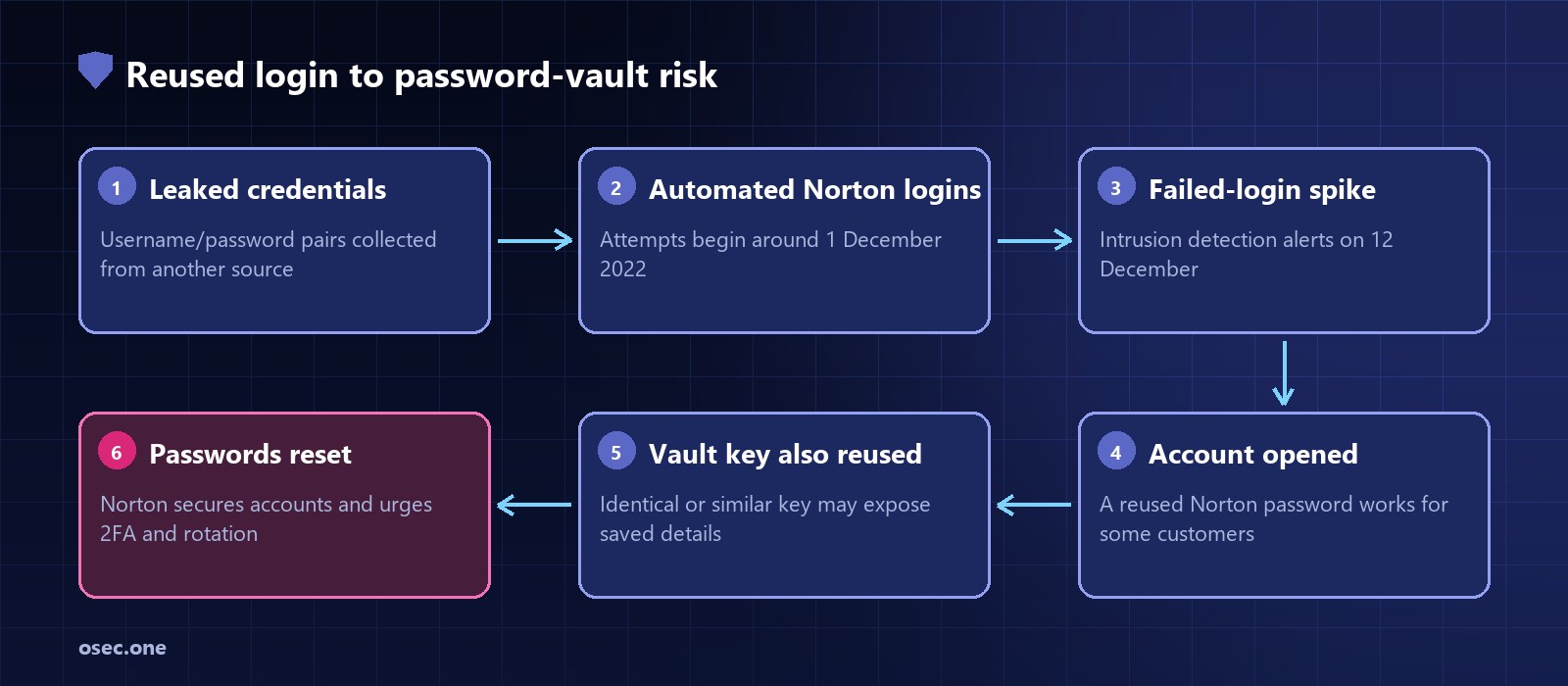
This was not an intrusion into Norton's network and it was not a theft of its password database. It was credential stuffing: a password leaked from site A was replayed at site B. What made this case unusually dangerous was what sat behind site B. The notified customers used Norton Password Manager. Norton said it could not rule out access to details stored there, especially where the Password Manager key was identical or very similar to the Norton account password.
"},{"id":146943,"block_type":"paragraph","html":"
That wording matters. 6,450 compromised accounts is not 6,450 confirmed vault downloads. The notice does not say every vault was opened or every saved password was read. It does say a valid reused login could reach names, phone numbers and mailing addresses, and that saved password-manager details might also have been obtained. This analysis keeps those boundaries intact.
Third party begins trying a list of usernames and passwords obtained from another source
The earliest identified activity, not necessarily the first request
12 Dec
Intrusion detection sees an unusually large volume of failed logins
About 11 elapsed days after the stated start
Early in investigation
Norton resets affected Norton passwords and takes measures to impede credential validation
Containment begins before the investigation is complete
Around 22 Dec
Investigation determines the source and method
About 10 days from the alert to the stated finding
9 Jan 2023
Date on the sample consumer notice filed in Vermont
It warns Password Manager users and offers credit monitoring
15-17 Jan
Gen Digital gives reporters the 6,450 and 925,000 populations
The two figures describe different groups, not a clean attempt/success pair
"},{"id":146947,"block_type":"paragraph","html":"
The notice says the 1 and 22 December dates are approximate, so an hour-by-hour dwell-time calculation would be false precision. The useful operational fact is simpler: the low-volume beginning preceded the conspicuous failed-login spike by about eleven days. A detector that only waits for a single IP to become noisy gives a distributed campaign room to establish itself.
925,000 and 6,450 are not failed and successful attempts
"},{"id":146949,"block_type":"paragraph","html":"
Several retellings turn the two figures into an attack success rate. The sources do not support that. Gen Digital's quoted description of 925,000 is inactive and active accounts secured that may have been targeted. It did not publish the number of HTTP requests, how many failed, how many username/password pairs were unique, or how many of those usernames had a Norton account. The 6,450 are customers whose accounts Gen Digital told TechCrunch were compromised and notified.
"},{"id":146950,"block_type":"html","html":"
Reported population
Count
Safe interpretation
Active and inactive accounts secured
925,000
May have been targeted; not a count of failed login requests
Customers notified
About 6,450
Accounts described as compromised; recipients used Password Manager
Total login attempts
Not published
No measured request or failure count
Vaults confirmed read
Not published
Norton could not rule out access; it did not confirm 6,450 vault reads
"},{"id":146951,"block_type":"paragraph","html":"
We can compare the two reported populations, as long as we label the result. 6,450 / 925,000 × 100 = 0.697%, or about one notified compromised customer per 143 secured accounts. That is not the bot's success rate: the denominator includes accounts that only may have been targeted, while the numerator is the password-manager customer notification group. The honest lesson is not “credential stuffing succeeds 0.7% of the time”; it is that a sub-one-percent-looking fraction can still create thousands of high-impact cases.
The attack path has two separate reuse decisions. First, a customer reused on Norton a username/password pair that had escaped from some other service. That let the attacker authenticate to the Norton account. Second, some customers may have made the Password Manager key identical or very similar to the Norton account password. Norton's notice singles out that condition when warning that saved details may have been obtained.
"},{"id":146954,"block_type":"html","html":"
Gate
What the attacker had
What could become visible
Norton account
Email/username and reused Norton password from another source
First name, last name, phone number and mailing address
Password Manager
A key identical or very similar to the account password, in Norton's warning
Details stored in the password manager; the notice does not enumerate or confirm which entries
Other online accounts
Any saved or reused credentials obtained from the first two gates
Possible follow-on account takeover; the notice warns that the pair could be tried elsewhere
"},{"id":146955,"block_type":"paragraph","html":"
Norton did not publish the vault's average size. A scenario table shows why uncertainty about vault access deserved urgent treatment without pretending it happened to everyone. If all 6,450 notified customers had 10, 50 or 100 stored entries and every vault were exposed, the envelope would be 64,500, 322,500 or 645,000 entries. Those are multiplication scenarios, not observed breach counts.
"},{"id":146956,"block_type":"html","html":"
Illustrative entries per vault
6,450 × entries
What is actually known
10
64,500
No vault-size distribution and no confirmed count of vaults read
50
322,500
100
645,000
"},{"id":146957,"block_type":"paragraph","html":"
A password manager is still the right tool for generating a different random password for every service. The failure mode here is using a human-made, reused password at the manager's front door—and then making the vault key the same or nearly the same. A manager cannot protect a secret that its user deliberately duplicates.
What the attacker could do, and what remains unknown
"},{"id":146959,"block_type":"paragraph","html":"
The consumer notice is specific about four account fields: first name, last name, phone number and mailing address. Those fields make follow-on phishing more convincing. A caller who knows the product, name and address can pose as support; a text to the known phone number can claim the vault is still at risk. The notice also warns that the known email/password combination may be tried on other online accounts.
"},{"id":146960,"block_type":"paragraph","html":"
It is not specific about the attacker, the source breach, bot infrastructure, number of requests, vault entry types, exact vault-key flow or evidence of downstream fraud. “Dark web” appears as an example of where the list may have come from, not an attribution. The notice offers credit monitoring, but it does not list Social Security numbers, payment-card numbers or dates of birth among the account fields that may have been viewed.
Credentials stolen elsewhere replayed at the live customer login
Developer environment compromise followed by cloud-storage access
What left the provider
No provider dataset reported stolen; individual accounts were opened
Backups containing customer account data and encrypted vault data
Password work
Online: a known reused account password succeeds immediately
Offline: encrypted vaults can be attacked without returning to LastPass
Who was in the risky group
About 6,450 notified compromised password-manager customers
The stolen backup population, not selected by password reuse at login
Fastest break
Unique account password plus MFA; separate vault key
Strong master password and rotation of exposed credentials; provider containment
"},{"id":146963,"block_type":"paragraph","html":"
Our LastPass 2022 analysis covers the backup-theft path. It is the wrong analogy for Norton. Norton is closer to PayPal's 2022 stuffing incident, except the thing behind a successful login was potentially a whole credential collection rather than one account's tax and profile data.
The incident gives site operators six places to intervene. The suggested thresholds below are starting points for a low-volume service; observe normal traffic first, then tune them. Do not let a per-IP limit become the only control, because a proxy pool can make every source look quiet.
"},{"id":146966,"block_type":"html","html":"
Attack step
Control
Practical starting point
Reused credential enters the system
Block known compromised passwords when set or changed; prompt an existing user to replace one after a risky login
Check every password change, not only registration
Distributed login attempts
Count failures across account, ASN, device and the whole service; separately count attempts for nonexistent accounts
Alert when an hour is 3× the same hour's 28-day median, with a minimum count to suppress tiny baselines
A correct password arrives
Require a second factor or passkey before creating a full session
Mandatory for vaults and administrative consoles; no remembered-device bypass after a risk event
New device opens sensitive data
Step up again for vault reveal/export, email change and recovery changes
Reauthenticate on every export and first reveal from a new device
Vault key resembles login password
Reject equality; warn on close variants without storing either secret in recoverable form
At minimum block exact equality and common suffix/prefix variants during setup
Compromise detected
Revoke sessions, reset the front-door password, require a new independent vault key and rotate exposed entries
Give users a checklist ordered by email, financial, work, social and remaining accounts
Customer notification
State what is confirmed, what is possible and which populations each number describes
Never turn accounts secured into “failed attempts” or possible vault access into confirmed vault theft
"},{"id":146967,"block_type":"paragraph","html":"
For a small site, the simplest way to remove the replay step is to remove the site password. Email-code, Google or Apple sign-in gives a combo list no password field to stuff. It moves trust to the inbox or identity provider—it does not make account recovery harmless—but it changes an attack that can test a million static pairs into one that must compromise each user's upstream account. The osec.one Login Protection guide shows why counting email addresses and wrong codes catches patterns a plain IP limit misses.
Norton reset the affected Norton password early in its investigation, took unspecified additional measures to impede validation and account access, encouraged two-factor authentication, and offered credit monitoring. Resetting the front-door password closes the session-entry route only if existing sessions are revoked too; the notice does not say whether they were. A customer still had to change the Password Manager key and the passwords of any stored accounts that might have been exposed.
"},{"id":146970,"block_type":"paragraph","html":"
The notice's best sentence is the one that separates provider compromise from customer harm: Norton's systems were not compromised, but the attacker knew and had used the recipient's credentials. “We were not breached” can be technically true while thousands of customers still need to rotate the keys to their digital lives. Detection and communication should be designed around that customer outcome, not around whether the attacker crossed the company's network boundary.
"},{"id":146971,"block_type":"cta","html":"
Use email codes, Google and Apple sign-in with no reusable site password and no OAuth app setup on your side. Free.
On 12 December 2022, Norton's intrusion detection saw an unusually large volume of failed account logins. The company traced the activity back to around 1 December: somebody was feeding usernames and passwords obtained elsewhere into login.norton.com. By around 22 December, Norton had concluded that the combinations worked on some accounts. Gen Digital later said it had secured 925,000 active and inactive accounts that may have been targeted; it told TechCrunch that notices went to about 6,450 customers whose accounts were compromised.
\n
Ad
\n
This was not an intrusion into Norton's network and it was not a theft of its password database. It was credential stuffing: a password leaked from site A was replayed at site B. What made this case unusually dangerous was what sat behind site B. The notified customers used Norton Password Manager. Norton said it could not rule out access to details stored there, especially where the Password Manager key was identical or very similar to the Norton account password.
\n
That wording matters. 6,450 compromised accounts is not 6,450 confirmed vault downloads. The notice does not say every vault was opened or every saved password was read. It does say a valid reused login could reach names, phone numbers and mailing addresses, and that saved password-manager details might also have been obtained. This analysis keeps those boundaries intact.
\n
\n
The timeline in the notice
\n
Date
What Norton said
What it means
Around 1 Dec 2022
Third party begins trying a list of usernames and passwords obtained from another source
The earliest identified activity, not necessarily the first request
12 Dec
Intrusion detection sees an unusually large volume of failed logins
About 11 elapsed days after the stated start
Early in investigation
Norton resets affected Norton passwords and takes measures to impede credential validation
Containment begins before the investigation is complete
Around 22 Dec
Investigation determines the source and method
About 10 days from the alert to the stated finding
9 Jan 2023
Date on the sample consumer notice filed in Vermont
It warns Password Manager users and offers credit monitoring
15-17 Jan
Gen Digital gives reporters the 6,450 and 925,000 populations
The two figures describe different groups, not a clean attempt/success pair
\n
The notice says the 1 and 22 December dates are approximate, so an hour-by-hour dwell-time calculation would be false precision. The useful operational fact is simpler: the low-volume beginning preceded the conspicuous failed-login spike by about eleven days. A detector that only waits for a single IP to become noisy gives a distributed campaign room to establish itself.
\n
925,000 and 6,450 are not failed and successful attempts
\n
Several retellings turn the two figures into an attack success rate. The sources do not support that. Gen Digital's quoted description of 925,000 is inactive and active accounts secured that may have been targeted. It did not publish the number of HTTP requests, how many failed, how many username/password pairs were unique, or how many of those usernames had a Norton account. The 6,450 are customers whose accounts Gen Digital told TechCrunch were compromised and notified.
\n
Reported population
Count
Safe interpretation
Active and inactive accounts secured
925,000
May have been targeted; not a count of failed login requests
Customers notified
About 6,450
Accounts described as compromised; recipients used Password Manager
Total login attempts
Not published
No measured request or failure count
Vaults confirmed read
Not published
Norton could not rule out access; it did not confirm 6,450 vault reads
\n
We can compare the two reported populations, as long as we label the result. 6,450 / 925,000 × 100 = 0.697%, or about one notified compromised customer per 143 secured accounts. That is not the bot's success rate: the denominator includes accounts that only may have been targeted, while the numerator is the password-manager customer notification group. The honest lesson is not “credential stuffing succeeds 0.7% of the time”; it is that a sub-one-percent-looking fraction can still create thousands of high-impact cases.
\n
How one reused password became a vault problem
\n
The attack path has two separate reuse decisions. First, a customer reused on Norton a username/password pair that had escaped from some other service. That let the attacker authenticate to the Norton account. Second, some customers may have made the Password Manager key identical or very similar to the Norton account password. Norton's notice singles out that condition when warning that saved details may have been obtained.
\n
Gate
What the attacker had
What could become visible
Norton account
Email/username and reused Norton password from another source
First name, last name, phone number and mailing address
Password Manager
A key identical or very similar to the account password, in Norton's warning
Details stored in the password manager; the notice does not enumerate or confirm which entries
Other online accounts
Any saved or reused credentials obtained from the first two gates
Possible follow-on account takeover; the notice warns that the pair could be tried elsewhere
\n
Norton did not publish the vault's average size. A scenario table shows why uncertainty about vault access deserved urgent treatment without pretending it happened to everyone. If all 6,450 notified customers had 10, 50 or 100 stored entries and every vault were exposed, the envelope would be 64,500, 322,500 or 645,000 entries. Those are multiplication scenarios, not observed breach counts.
\n
Illustrative entries per vault
6,450 × entries
What is actually known
10
64,500
No vault-size distribution and no confirmed count of vaults read
50
322,500
100
645,000
\n
A password manager is still the right tool for generating a different random password for every service. The failure mode here is using a human-made, reused password at the manager's front door—and then making the vault key the same or nearly the same. A manager cannot protect a secret that its user deliberately duplicates.
\n
What the attacker could do, and what remains unknown
\n
The consumer notice is specific about four account fields: first name, last name, phone number and mailing address. Those fields make follow-on phishing more convincing. A caller who knows the product, name and address can pose as support; a text to the known phone number can claim the vault is still at risk. The notice also warns that the known email/password combination may be tried on other online accounts.
\n
It is not specific about the attacker, the source breach, bot infrastructure, number of requests, vault entry types, exact vault-key flow or evidence of downstream fraud. “Dark web” appears as an example of where the list may have come from, not an attribution. The notice offers credit monitoring, but it does not list Social Security numbers, payment-card numbers or dates of birth among the account fields that may have been viewed.
\n
Why this is not LastPass 2022
\n
Norton, Dec 2022
LastPass, 2022
Initial path
Credentials stolen elsewhere replayed at the live customer login
Developer environment compromise followed by cloud-storage access
What left the provider
No provider dataset reported stolen; individual accounts were opened
Backups containing customer account data and encrypted vault data
Password work
Online: a known reused account password succeeds immediately
Offline: encrypted vaults can be attacked without returning to LastPass
Who was in the risky group
About 6,450 notified compromised password-manager customers
The stolen backup population, not selected by password reuse at login
Fastest break
Unique account password plus MFA; separate vault key
Strong master password and rotation of exposed credentials; provider containment
\n
Our LastPass 2022 analysis covers the backup-theft path. It is the wrong analogy for Norton. Norton is closer to PayPal's 2022 stuffing incident, except the thing behind a successful login was potentially a whole credential collection rather than one account's tax and profile data.
\n
Controls that break each step
\n
The incident gives site operators six places to intervene. The suggested thresholds below are starting points for a low-volume service; observe normal traffic first, then tune them. Do not let a per-IP limit become the only control, because a proxy pool can make every source look quiet.
\n
Attack step
Control
Practical starting point
Reused credential enters the system
Block known compromised passwords when set or changed; prompt an existing user to replace one after a risky login
Check every password change, not only registration
Distributed login attempts
Count failures across account, ASN, device and the whole service; separately count attempts for nonexistent accounts
Alert when an hour is 3× the same hour's 28-day median, with a minimum count to suppress tiny baselines
A correct password arrives
Require a second factor or passkey before creating a full session
Mandatory for vaults and administrative consoles; no remembered-device bypass after a risk event
New device opens sensitive data
Step up again for vault reveal/export, email change and recovery changes
Reauthenticate on every export and first reveal from a new device
Vault key resembles login password
Reject equality; warn on close variants without storing either secret in recoverable form
At minimum block exact equality and common suffix/prefix variants during setup
Compromise detected
Revoke sessions, reset the front-door password, require a new independent vault key and rotate exposed entries
Give users a checklist ordered by email, financial, work, social and remaining accounts
Customer notification
State what is confirmed, what is possible and which populations each number describes
Never turn accounts secured into “failed attempts” or possible vault access into confirmed vault theft
\n
For a small site, the simplest way to remove the replay step is to remove the site password. Email-code, Google or Apple sign-in gives a combo list no password field to stuff. It moves trust to the inbox or identity provider—it does not make account recovery harmless—but it changes an attack that can test a million static pairs into one that must compromise each user's upstream account. The osec.one Login Protection guide shows why counting email addresses and wrong codes catches patterns a plain IP limit misses.
\n
The response, read against the attack
\n
Norton reset the affected Norton password early in its investigation, took unspecified additional measures to impede validation and account access, encouraged two-factor authentication, and offered credit monitoring. Resetting the front-door password closes the session-entry route only if existing sessions are revoked too; the notice does not say whether they were. A customer still had to change the Password Manager key and the passwords of any stored accounts that might have been exposed.
\n
The notice's best sentence is the one that separates provider compromise from customer harm: Norton's systems were not compromised, but the attacker knew and had used the recipient's credentials. “We were not breached” can be technically true while thousands of customers still need to rotate the keys to their digital lives. Detection and communication should be designed around that customer outcome, not around whether the attacker crossed the company's network boundary.
\n
Use email codes, Google and Apple sign-in with no reusable site password and no OAuth app setup on your side. Free.
Norton LifeLock 2022: 6,450 password-manager accounts at risk after credential stuffing
On 12 December 2022, Norton's intrusion detection saw an unusually large volume of failed account logins. The company traced the activity back to around 1 December: somebody was feeding usernames and passwords obtained elsewhere into login.norton.com. By around 22 December, Norton had concluded that the combinations worked on some accounts. Gen Digital later said it had secured 925,000 active and inactive accounts that may have been targeted; it told TechCrunch that notices went to about 6,450 customers whose accounts were compromised.
Ad
This was not an intrusion into Norton's network and it was not a theft of its password database. It was credential stuffing: a password leaked from site A was replayed at site B. What made this case unusually dangerous was what sat behind site B. The notified customers used Norton Password Manager. Norton said it could not rule out access to details stored there, especially where the Password Manager key was identical or very similar to the Norton account password.
That wording matters. 6,450 compromised accounts is not 6,450 confirmed vault downloads. The notice does not say every vault was opened or every saved password was read. It does say a valid reused login could reach names, phone numbers and mailing addresses, and that saved password-manager details might also have been obtained. This analysis keeps those boundaries intact.
The timeline in the notice
Date
What Norton said
What it means
Around 1 Dec 2022
Third party begins trying a list of usernames and passwords obtained from another source
The earliest identified activity, not necessarily the first request
12 Dec
Intrusion detection sees an unusually large volume of failed logins
About 11 elapsed days after the stated start
Early in investigation
Norton resets affected Norton passwords and takes measures to impede credential validation
Containment begins before the investigation is complete
Around 22 Dec
Investigation determines the source and method
About 10 days from the alert to the stated finding
9 Jan 2023
Date on the sample consumer notice filed in Vermont
It warns Password Manager users and offers credit monitoring
15-17 Jan
Gen Digital gives reporters the 6,450 and 925,000 populations
The two figures describe different groups, not a clean attempt/success pair
The notice says the 1 and 22 December dates are approximate, so an hour-by-hour dwell-time calculation would be false precision. The useful operational fact is simpler: the low-volume beginning preceded the conspicuous failed-login spike by about eleven days. A detector that only waits for a single IP to become noisy gives a distributed campaign room to establish itself.
925,000 and 6,450 are not failed and successful attempts
Several retellings turn the two figures into an attack success rate. The sources do not support that. Gen Digital's quoted description of 925,000 is inactive and active accounts secured that may have been targeted. It did not publish the number of HTTP requests, how many failed, how many username/password pairs were unique, or how many of those usernames had a Norton account. The 6,450 are customers whose accounts Gen Digital told TechCrunch were compromised and notified.
Reported population
Count
Safe interpretation
Active and inactive accounts secured
925,000
May have been targeted; not a count of failed login requests
Customers notified
About 6,450
Accounts described as compromised; recipients used Password Manager
Total login attempts
Not published
No measured request or failure count
Vaults confirmed read
Not published
Norton could not rule out access; it did not confirm 6,450 vault reads
We can compare the two reported populations, as long as we label the result. 6,450 / 925,000 × 100 = 0.697%, or about one notified compromised customer per 143 secured accounts. That is not the bot's success rate: the denominator includes accounts that only may have been targeted, while the numerator is the password-manager customer notification group. The honest lesson is not “credential stuffing succeeds 0.7% of the time”; it is that a sub-one-percent-looking fraction can still create thousands of high-impact cases.
How one reused password became a vault problem
The attack path has two separate reuse decisions. First, a customer reused on Norton a username/password pair that had escaped from some other service. That let the attacker authenticate to the Norton account. Second, some customers may have made the Password Manager key identical or very similar to the Norton account password. Norton's notice singles out that condition when warning that saved details may have been obtained.
Gate
What the attacker had
What could become visible
Norton account
Email/username and reused Norton password from another source
First name, last name, phone number and mailing address
Password Manager
A key identical or very similar to the account password, in Norton's warning
Details stored in the password manager; the notice does not enumerate or confirm which entries
Other online accounts
Any saved or reused credentials obtained from the first two gates
Possible follow-on account takeover; the notice warns that the pair could be tried elsewhere
Norton did not publish the vault's average size. A scenario table shows why uncertainty about vault access deserved urgent treatment without pretending it happened to everyone. If all 6,450 notified customers had 10, 50 or 100 stored entries and every vault were exposed, the envelope would be 64,500, 322,500 or 645,000 entries. Those are multiplication scenarios, not observed breach counts.
Illustrative entries per vault
6,450 × entries
What is actually known
10
64,500
No vault-size distribution and no confirmed count of vaults read
50
322,500
100
645,000
A password manager is still the right tool for generating a different random password for every service. The failure mode here is using a human-made, reused password at the manager's front door—and then making the vault key the same or nearly the same. A manager cannot protect a secret that its user deliberately duplicates.
What the attacker could do, and what remains unknown
The consumer notice is specific about four account fields: first name, last name, phone number and mailing address. Those fields make follow-on phishing more convincing. A caller who knows the product, name and address can pose as support; a text to the known phone number can claim the vault is still at risk. The notice also warns that the known email/password combination may be tried on other online accounts.
It is not specific about the attacker, the source breach, bot infrastructure, number of requests, vault entry types, exact vault-key flow or evidence of downstream fraud. “Dark web” appears as an example of where the list may have come from, not an attribution. The notice offers credit monitoring, but it does not list Social Security numbers, payment-card numbers or dates of birth among the account fields that may have been viewed.
Why this is not LastPass 2022
Norton, Dec 2022
LastPass, 2022
Initial path
Credentials stolen elsewhere replayed at the live customer login
Developer environment compromise followed by cloud-storage access
What left the provider
No provider dataset reported stolen; individual accounts were opened
Backups containing customer account data and encrypted vault data
Password work
Online: a known reused account password succeeds immediately
Offline: encrypted vaults can be attacked without returning to LastPass
Who was in the risky group
About 6,450 notified compromised password-manager customers
The stolen backup population, not selected by password reuse at login
Fastest break
Unique account password plus MFA; separate vault key
Strong master password and rotation of exposed credentials; provider containment
Our LastPass 2022 analysis covers the backup-theft path. It is the wrong analogy for Norton. Norton is closer to PayPal's 2022 stuffing incident, except the thing behind a successful login was potentially a whole credential collection rather than one account's tax and profile data.
Controls that break each step
The incident gives site operators six places to intervene. The suggested thresholds below are starting points for a low-volume service; observe normal traffic first, then tune them. Do not let a per-IP limit become the only control, because a proxy pool can make every source look quiet.
Attack step
Control
Practical starting point
Reused credential enters the system
Block known compromised passwords when set or changed; prompt an existing user to replace one after a risky login
Check every password change, not only registration
Distributed login attempts
Count failures across account, ASN, device and the whole service; separately count attempts for nonexistent accounts
Alert when an hour is 3× the same hour's 28-day median, with a minimum count to suppress tiny baselines
A correct password arrives
Require a second factor or passkey before creating a full session
Mandatory for vaults and administrative consoles; no remembered-device bypass after a risk event
New device opens sensitive data
Step up again for vault reveal/export, email change and recovery changes
Reauthenticate on every export and first reveal from a new device
Vault key resembles login password
Reject equality; warn on close variants without storing either secret in recoverable form
At minimum block exact equality and common suffix/prefix variants during setup
Compromise detected
Revoke sessions, reset the front-door password, require a new independent vault key and rotate exposed entries
Give users a checklist ordered by email, financial, work, social and remaining accounts
Customer notification
State what is confirmed, what is possible and which populations each number describes
Never turn accounts secured into “failed attempts” or possible vault access into confirmed vault theft
For a small site, the simplest way to remove the replay step is to remove the site password. Email-code, Google or Apple sign-in gives a combo list no password field to stuff. It moves trust to the inbox or identity provider—it does not make account recovery harmless—but it changes an attack that can test a million static pairs into one that must compromise each user's upstream account. The osec.one Login Protection guide shows why counting email addresses and wrong codes catches patterns a plain IP limit misses.
The response, read against the attack
Norton reset the affected Norton password early in its investigation, took unspecified additional measures to impede validation and account access, encouraged two-factor authentication, and offered credit monitoring. Resetting the front-door password closes the session-entry route only if existing sessions are revoked too; the notice does not say whether they were. A customer still had to change the Password Manager key and the passwords of any stored accounts that might have been exposed.
The notice's best sentence is the one that separates provider compromise from customer harm: Norton's systems were not compromised, but the attacker knew and had used the recipient's credentials. “We were not breached” can be technically true while thousands of customers still need to rotate the keys to their digital lives. Detection and communication should be designed around that customer outcome, not around whether the attacker crossed the company's network boundary.
Use email codes, Google and Apple sign-in with no reusable site password and no OAuth app setup on your side. Free.