Over the US Memorial Day weekend of 2023 the Cl0p extortion group used one SQL injection flaw in MOVEit Transfer, Progress Software's managed file transfer product, to steal files from servers around the world. They didn't encrypt anything. They took data and emailed executives.
By June 2024 Emsisoft's count, built from breach notices and filings, stood at 2,773 organisations and 95.8 million people. Most of those organisations never ran MOVEit themselves: their payroll provider, benefits administrator or student records service did. This is a case study in how one bug in an internet-facing app turns into a supply chain breach, and what to do about the apps you have like it.
The target: a file transfer server facing the internet
Managed file transfer (MFT) apps exist to move sensitive files between organisations: payroll exports, claims, student records, bank files. To do that they sit on the internet with a web interface for partners, and they tend to keep files long after the transfer is done. That makes them very attractive: one server, reachable by anyone, holding many organisations' most sensitive data.
Cl0p had done this before: Accellion FTA in 2020 and 2021, and Fortra GoAnywhere MFT in January 2023, where it claimed about 130 victims in ten days. Kroll later found evidence that the group had been testing the MOVEit flaw as early as July 2021.
Step 1: SQL injection, no login needed
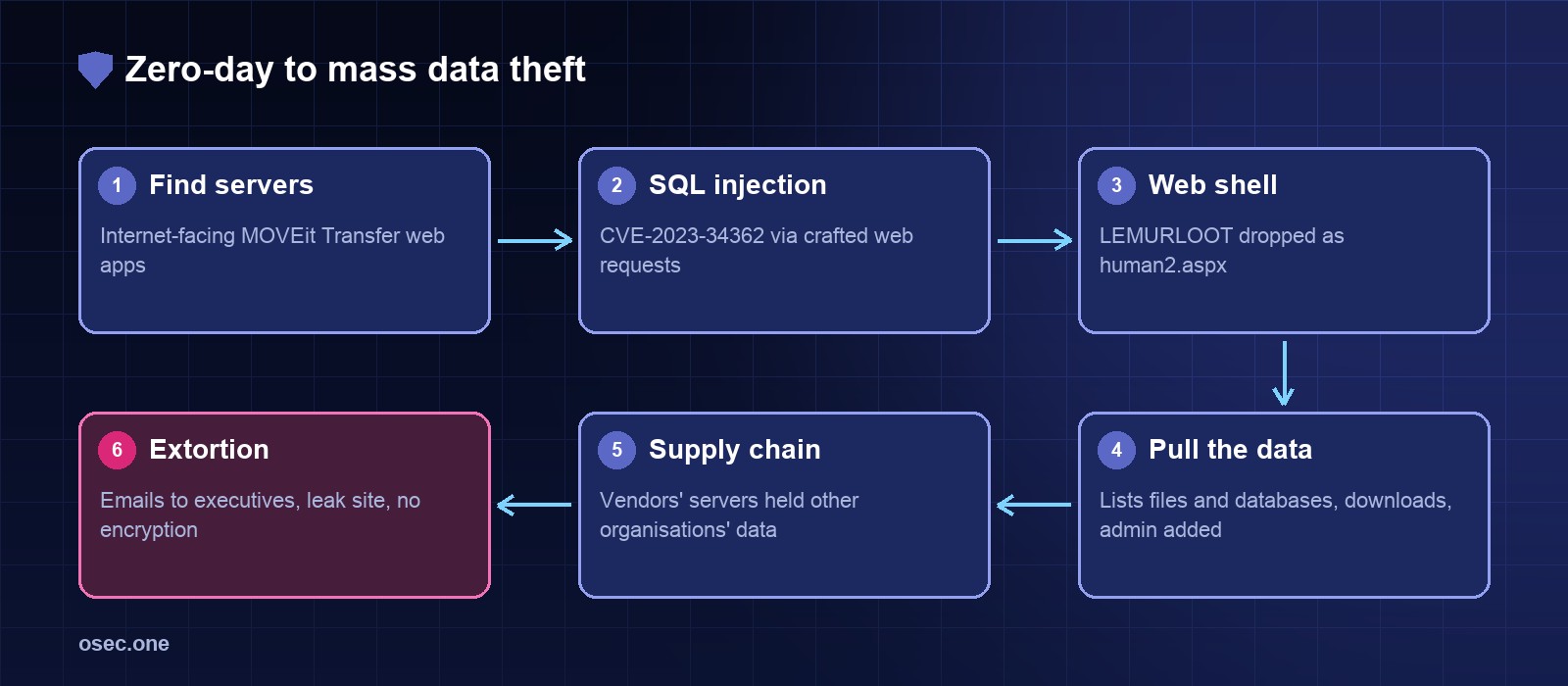
CVE-2023-34362 (CVSS 9.8) let an unauthenticated attacker send crafted web requests that reached a SQL injection in MOVEit Transfer's web application. Researchers who reproduced it described a chain: requests that set up session state, an injection that pulls an administrator-level token from the database, and then the application's own features used with that access to write a file to the web server. We're not reproducing the chain here; the point is that no password, MFA or user action stood in the way. If the web interface was reachable, the server was exposed.
Mass exploitation began on 27 May 2023. Progress published its advisory and patches on 31 May, told customers to cut off HTTP and HTTPS traffic to MOVEit Transfer until patched, and CISA added the CVE to its Known Exploited Vulnerabilities list on 2 June. Code reviews then found two more SQL injection flaws, disclosed on 9 June (CVE-2023-35036) and 15 June (CVE-2023-35708).
Step 2: a web shell called human2.aspx
The attackers dropped a small ASP.NET web shell that Mandiant named LEMURLOOT, saved as human2.aspx next to MOVEit's real human.aspx so it would pass a quick glance. According to CISA's advisory it only answered requests carrying a password in an HTTP header called X-siLock-Comment, and it could:
• list the files and folders stored in MOVEit and download any of them;
• read the instance's Azure Blob Storage settings, for cloud-hosted file stores;
• enumerate the SQL databases;
• create an administrator account (seen with the name Health Check Service) and delete it again.
Step 3: take the data, skip the encryption
Data was pulled within days, often within hours of the first request, across hundreds of servers at once. On 6 June Cl0p posted a notice on its leak site telling victims to get in touch by 14 June, emailed executives directly and published data from those who didn't pay. Nothing was encrypted, so there was no outage to tip anyone off. Many victims learned of the theft from Progress's advisory or from Cl0p itself.
Step 4: the supply chain multiplies it
The count grew for more than a year because one MOVEit customer often held data for hundreds of others:
• The National Student Clearinghouse, whose MOVEit server was hit on 30 May, listed nearly 890 schools and colleges affected.
• UK payroll provider Zellis exposed staff data of clients including British Airways, the BBC and Boots.
• The largest single counts in Emsisoft's tally: Maximus (11.3 million people), Welltok (10 million), Delta Dental of California (6.9 million) and the Louisiana Office of Motor Vehicles (6 million).
• By sector: education 39.1%, health 20.1%, finance and professional services 13.3%. Organisations based in the US were 78.9% of the total.
Most MOVEit victims never ran MOVEit. They had sent their data to someone who did.
The fallout is still running. Hundreds of class actions were consolidated in federal court in Massachusetts, where a motion to dismiss most claims was denied in December 2024. The SEC closed its investigation of Progress in August 2024 without recommending action.
Controls that break each step
Don't put the web interface where anyone can reach it
• Keep an inventory of every internet-facing hostname, including file transfer, VPN, admin and "temporary" partner portals. osec Scan grades TLS and security headers on any public URL, a quick first pass over each forgotten host.
• Put MFT and admin interfaces behind a VPN, an IP allowlist for known partners, or a reverse proxy that requires sign-in before the app sees a request. An unauthenticated SQL injection can't be reached by someone who can't connect.
Patch like it's an incident
• Subscribe to your vendors' security advisories and to CISA's KEV list. When an internet-facing app has an exploited flaw, the clock is in hours.
• Have a tested way to take an app offline or block it at the edge, as Progress advised, while you patch.
• A WAF with SQL injection rules helps against variants, but don't count on it against a zero-day.
Detect a web shell and a new admin
• File integrity monitoring on the web root: alert on any new .aspx, .php or .jsp file you didn't deploy.
• Alert on new administrator accounts and on large or unusual downloads, and look at outbound data volume per server.
• Keep web server logs off the box, long enough to look back weeks; MOVEit investigations relied on them.
Hold less, and know who holds yours
• Set retention on file transfer servers so files are deleted after delivery. Data that isn't there can't be stolen.
• List which vendors process your data and on what platforms, and require prompt breach notification in contracts. When the next MOVEit comes, you want to ask "are we exposed through anyone?" on day one, not learn it from a letter months later.
The lesson
MOVEit wasn't a sophisticated intrusion. It was one classic web bug in an app built to be reachable from the internet and trusted with other people's data, found and used at scale by a group that had done the same thing twice before. Make such apps hard to reach, quick to patch and light on stored data. Related reading: Snowflake 2024, another mass data theft with extortion and no encryption, and Polyfill.io, a supply chain attack through a trusted script.
osec.one has small security tools for sites that face the internet, with no DNS move: header and TLS scans, uptime and certificate monitoring, CSP reports and login protection. Free for 500 requests a day.
See the toolsSources: CISA and FBI advisory AA23-158A: CL0P exploits MOVEit vulnerability; Emsisoft: Unpacking the MOVEit breach, statistics and analysis; Imperva: CVE-2023-34362, an attack chain that retrieves sensitive information; ThreatDown: MOVEit Transfer vulnerability actively exploited (Progress's mitigation steps); Cisco Talos: Active exploitation of MOVEit; ThreatDown: MOVEit discloses a third vulnerability; BleepingComputer: National Student Clearinghouse breach impacts 890 schools; Security Affairs: British Airways, BBC and Boots impacted by the Zellis breach; Dark Reading: Progress announces conclusion of SEC investigation into MOVEit; Law360: MOVEit data breach MDL survives dismissal bid.