This write-up works from the consent order itself (index no. 451787/2019, the court's own file) and from press reports of the complaint, which Dunkin' neither admitted nor denied. It sets out the timeline, does the arithmetic on the one traffic sample that was published, shows what the order requires item by item (a useful template for anyone running a login with money behind it), and ends with the controls that break each step. It differs from our Chick-fil-A write-up, which is mostly about what attackers do with a loyalty account. Here the interesting part is what happened between the warning and the response.
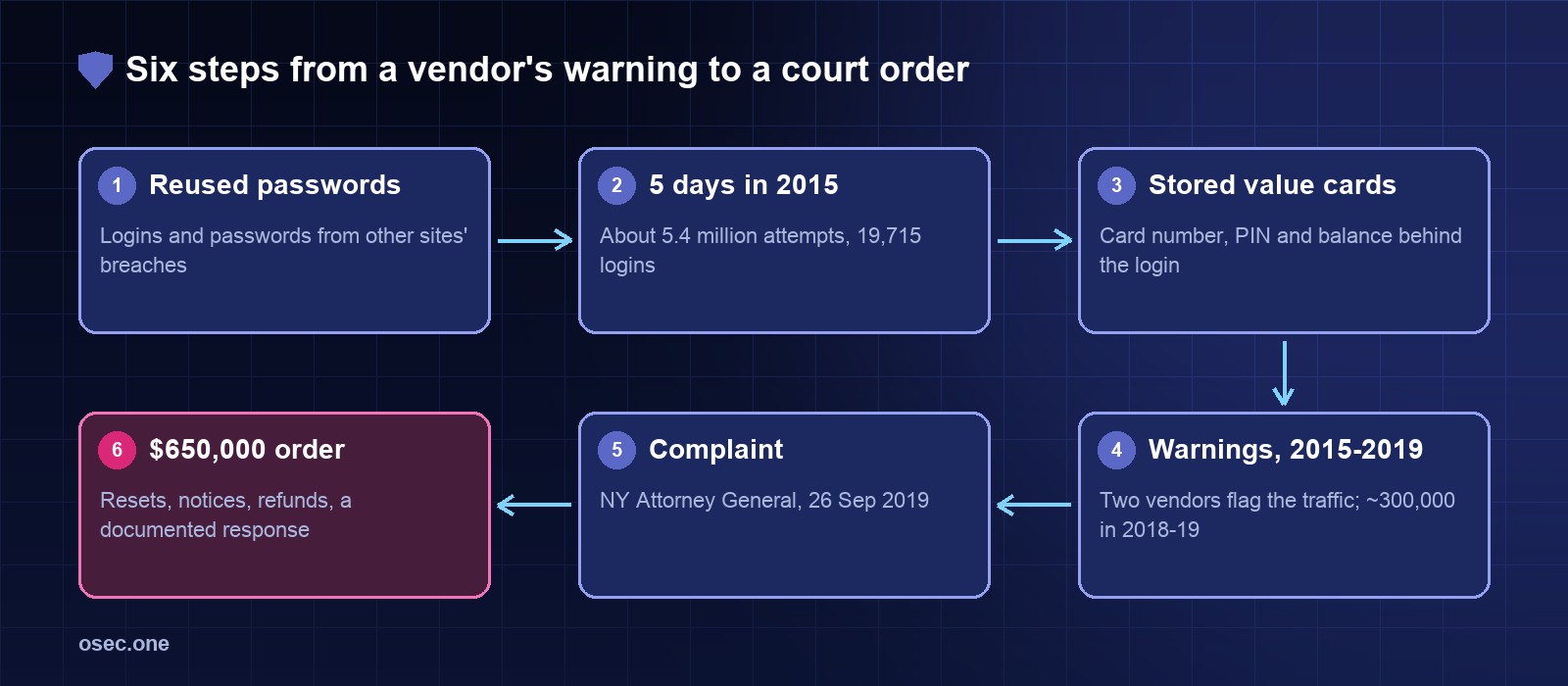
"},{"id":145907,"block_type":"screenshot","html":"Six steps. Dunkin's own systems were not breached; the logins were real, the passwords came from elsewhere."},{"id":145908,"block_type":"heading_h2","html":"
Timeline, from the order and the reports
"},{"id":145909,"block_type":"html","html":"
\n
Date
What happened
Source
\n
Early 2015
Brute-force and stuffing logins against DD Perks begin
Complaint, as reported by TechTarget
\n
Mid-May 2015
Dunkin' personnel recognise the attacks (per the complaint)
TechTarget
\n
June-July 2015
Mobile app vendor CorFire discovers the attacks, tells Dunkin', sends a presentation
TechTarget
\n
Aug 2015
CorFire gives Dunkin' a list of about 19,715 affected customers and a way to spot the malicious traffic
Consent order ¶3(a); TechTarget
\n
Late Mar 2018
Dunkin' hires a security vendor to block automated attacks; monthly customer reports of compromised accounts are 3 to 4 times the August 2015 level (per the complaint)
TechTarget
\n
Oct-Nov 2018, Jan 2019
Shape Security tells Dunkin' about attacks affecting about 300,000 customers (attack window 1 Oct 2018 to 31 Jan 2019); notices go out Nov 2018 and Feb 2019
Consent order ¶3(b), Appendix B
\n
26 Sep 2019
New York v. Dunkin' Brands, Inc. filed in Supreme Court, New York County (Commercial Division)
Consent order recitals
\n
Jan-Apr 2020
Dunkin' staff find more accounts accessed without authorisation
Consent order ¶3(c)
\n
Feb 2020
The Attorney General gives Dunkin' about 4,800 further account identifiers
Consent order ¶3(h)
\n
21-22 Sep 2020
Stipulation signed 21 Sep; consent order so-ordered 22 Sep (the court stamp reads 09/22/2020)
Consent order
\n
"},{"id":145910,"block_type":"paragraph","html":"
Two gaps stand out. From the 2015 list to the 2018 report is 38 months (August 2015 to October 2018), during which, per the complaint, monthly customer reports of compromised accounts reached three or four times the August 2015 level by early 2018. From the complaint to the order is 361 days (26 September 2019 to 21 September 2020). The order is a settlement: Dunkin' says it cooperated, reset passwords and sent notices at the time, and had improved its security before the case ended. The Attorney General's position is that the responses were not enough. Both can be partly true, and the court never ruled between them.
The notices Dunkin' was required to send say it plainly: the logins used "usernames and passwords obtained elsewhere (not through any compromise of Dunkin's own internal systems)" in 2015, and "likely obtained through other companies' security breaches" in 2018-19. A DD Perks login is an email address and a password, so every combo list from every breach is a candidate list. The attacker only needs customers who reused a password.
The complaint's one published traffic figure comes from CorFire's analysis of five days of traffic: about 5.4 million access attempts and 19,715 successful logins (TechTarget's report of the complaint). The order uses the same 19,715 for the customer list identified in August 2015. The arithmetic is below. For 2018-19 the number is the vendor's count of affected customers, not attempts.
The order's definition of customer information is a good inventory of the prize: name, address, phone, email, username and password, device ID, the 16-digit DD stored value card number, PIN and balance. The notices list what was "potentially obtained": first and last name, email, the 16-digit DD Perks account number, the PIN and, in some cases, balances. A card number plus PIN is spendable without the account, which is why the order requires moving balances to new card numbers, not just resetting passwords.
The complaint says an account with Auto Reload switched on refilled the card from the customer's funding source whenever the balance fell, so an attacker could keep spending "indefinitely" (as TechTarget reported it). The notice for the 2020 group describes what Dunkin' later looked for in the card data: "unusual registration and de-registration activity", use of a card by a different account holder, and unusual transaction activity. Cards being moved between accounts is the signature of resale of drained or loaded cards. This part is an inference from the notice wording, not a finding.
The press release puts the stolen amount at "tens of thousands of dollars" from DD cards, with tens of thousands of accounts compromised "within a matter of months". No total was published, and the order doesn't state one. That is the central difficulty of this case: a stored value card has no issuer to run a fraud model, and a customer who loses $20 rarely calls anyone, so the true loss can only be reconstructed from the card's own transaction history, which is exactly what the order makes Dunkin' hand over.
The AG's allegations are that Dunkin' did not investigate to find which accounts were compromised, what information was taken or whether funds were stolen; did not notify customers or reset passwords or freeze cards; and did not put suitable safeguards into the mobile app after learning of the attacks. It also alleged that Dunkin' misrepresented its safeguards, under General Business Law §§ 349 and 350, and breached the breach-notification law, § 899-aa. Dunkin' disputed all of it in its statement.
The sample is the only measured rate in the file, so everything else here builds on it:
"},{"id":145926,"block_type":"html","html":"
\n
Quantity
Working
Result
\n
Success rate in the sample
19,715 / 5,400,000
0.365%, about 1 login per 274 attempts
\n
Attempts a day
5,400,000 / 5
1,080,000
\n
Attempts a second
1,080,000 / 86,400
12.5
\n
Successful logins a day
19,715 / 5
3,943
\n
Failures per success
5,380,285 / 19,715
273
\n
"},{"id":145927,"block_type":"paragraph","html":"
A 12.5-a-second login rate is not subtle. It is a steady machine rate on one endpoint, around the clock. What hides it is the success rate: at 0.365% each account sees one failed or successful try with one known password, so per-account lockouts never trip. A failure ratio of 99.6% on the login route is visible in an hour of metrics, though, and that is the signal the vendors were reading.
"},{"id":145928,"block_type":"paragraph","html":"
For 2018-19 we have a count but no attempts. The window runs 1 October 2018 to 31 January 2019, which is 31 + 30 + 31 + 31 = 123 days, so 300,000 / 123 = about 2,439 affected customers a day. If that run had the 2015 success rate (an assumption, since no 2018 rate was published), 300,000 / 0.00365 = 82 million attempts, 668,000 a day or about 7.7 a second. Treat that as an order of magnitude, not a finding.
"},{"id":145929,"block_type":"paragraph","html":"
What the penalty works out to, for scale:
"},{"id":145930,"block_type":"html","html":"
\n
Calculation
Result
\n
$650,000 / 19,715 (2015 list only)
$32.97 an account
\n
$650,000 / (19,715 + 300,000)
$2.03 an account
\n
$650,000 / 4,800 (accounts the AG added in 2020)
$135.42 an account
\n
"},{"id":145931,"block_type":"paragraph","html":"
These are not what anyone was paid per victim: the penalty goes to the State, refunds are separate, and the order's customer classes cover New York customers from those lists, a subset of the totals. They do show the order of magnitude. A fine measured in dollars per affected account is cheap next to the cost of a login protection programme only if the fine is the whole cost, and here it was not: Dunkin' also had to run notices, resets, a 90-day refund window and records for years, below.
Most coverage stops at the $650,000. The order is more useful than the figure, because it spells out what a regulator expects once you know your logins are being stuffed. The paragraph numbers are the order's own.
"},{"id":145934,"block_type":"html","html":"
\n
Order
Requirement
Deadline or term
\n
¶6-7
A written security programme with \"reasonable measures to protect Customer Accounts against brute force and credential stuffing attacks\"
Six years from the effective date (¶23)
\n
¶8
On reasonable suspicion of an attack: investigate promptly whether it is ongoing, its cause and scope, the accounts affected and the data categories touched; document each step
Keep the documentation at least 5 years
\n
¶9
Accounts with no stored card, a masked card, or no private information taken: reset password, tell the customer a third party logged in, answer refund requests
On confirmed or reasonably believed access
\n
¶10
Accounts where an unmasked card number was taken: notify under § 899-aa, reset password, move the balance to a new card number, refund unauthorised purchases
Same trigger
\n
¶11-14
Reset passwords and send the appendix letters and emails to the 2015, 2018-19, 2020 and AG-identified customers
Within 30 days of 22 Sep 2020
\n
¶15
Send a customer their card's full history (registrations, de-registrations, transactions, reloads) when they ask, by email or phone
Within 3 business days, for 90 days after the notices
\n
¶16
Refund all reported unauthorised use unless a reasonable review of the account history shows otherwise; a missing receipt alone is not grounds to refuse
Reports accepted for 90 days after the notices
\n
¶17-18
Give the AG the customer spreadsheet 7 days before sending, then a refund report
Report within 180 days of the notice date
\n
¶19
$650,000 in penalties and costs; 9% annual interest if late
Within 14 days
\n
"},{"id":145935,"block_type":"paragraph","html":"
Counted from the stamp date of 22 September 2020, the payment was due on 6 October, the resets and letters by 22 October, and the programme duties in ¶6-10 ran to 22 September 2026. Those six years have now passed, which says nothing about whether the practices continue: it means only that the court is no longer holding them in place.
"},{"id":145936,"block_type":"paragraph","html":"
The refund rule in ¶16 matters most to anyone who runs stored value. It reverses the usual burden. The customer need not prove the theft; the company has to find a sign in the card's own history that it was not theft, and "you gave us no receipt" is not one.
Appendix A letter or Appendix F email, password reset, new card number
\n
2018/19 customers (¶3b)
About 300,000, flagged by Shape Security Oct-Nov 2018 and Jan 2019
Appendix B \"supplemental notice\" or Appendix G email; Dunkin' had already sent notices Nov 2018 and Feb 2019
\n
2020 customers (¶3c)
Accounts found accessed 1 Jan to 30 Apr 2020
Appendix D or H email
\n
Proactively identified (¶3j)
Customers whose card was, or may have been, used without authorisation since 1 Jan 2015 and who never complained
Appendix C letter
\n
AG identified (¶3h)
About 4,800 accounts the AG supplied in Feb 2020
Appendix E email
\n
"},{"id":145939,"block_type":"paragraph","html":"
The Proactively Identified group is the telling one: customers whose cards showed odd registrations, cross-account use or odd transactions, who had never reported anything. They were found by looking at the card history, years later. Had that review run in 2015 against the pattern CorFire described, the same people could have been told then.
Roku's two waves ended in mandatory two-factor sign-in, and PayPal's order in required MFA too. The Dunkin' order does not require MFA. It requires a response: investigate, document, reset, notify, refund. That is a lower bar than a control, which makes it a floor worth meeting before you argue about anything else.
These are our starting points for a consumer app with stored value, not standards. Run each in report-only mode for a week before blocking.
"},{"id":145945,"block_type":"html","html":"
\n
Step
Control
Starting point
\n
Reused password
Check new and existing passwords against a breached-password list (NIST SP 800-63B-4 requires a blocklist for new passwords); force a reset on a hit
Reset any account whose password is on the list at next login
\n
High-volume logins
Alarm on the aggregate: login failure ratio, attempts per second on the login route, share of tries for emails you have no account for
At 99.6% failures and 12 attempts a second the 2015 pattern is obvious; page at 3 times the 7-day median
\n
Card number and PIN behind the login
Don't show or return the full number; mask it; ask for a code before the card is added, moved or shown
Re-check on a new device or when a card is registered to a second account
\n
Auto Reload
Cap reloads per day; email on every reload and every funding change; delay the first reload on a new device
Daily reload cap and an email on each event
\n
Cards moving between accounts
Alert on a card registered to more than one account, and on registration followed quickly by de-registration
Review any card with 2 or more registrations in 30 days
\n
Vendor warnings
Treat a vendor or partner report as an incident: ticket, owner, timer. Write the investigation down, as ¶8 requires
Name an owner within 1 day; written scope within 5
\n
Response
Playbook for the order's steps: reset, notify, move balances, refund without demanding receipts, keep records 5 years
Rehearse once a year with a 1,000-account test list
\n
"},{"id":145946,"block_type":"paragraph","html":"
The cheapest fix is the same as in the other stuffing cases: leave no password to replay. A combo list has nothing to try on a sign-in that takes only an email code, Google or Apple. That moves the risk to the inbox rather than removing it, but an attacker must break into a mail account per victim rather than replay one list. If you keep passwords, the sign-in rules in our write-up on counting emails and wrong codes and osec Login Protection cover the aggregate signal in the second row.
"},{"id":145947,"block_type":"cta","html":"
Sign-ins with email codes, Google and Apple: no password to stuff, no OAuth app to set up on your side. Free.
• The complaint itself isn't linked from the Attorney General's page; the five-day figures (5.4 million attempts, 19,715 logins), the mid-May 2015 date and the 2018 dates for the vendor engagement come from TechTarget's report of it, so they are allegations. • The total amount stolen was never published; the press release says only tens of thousands of dollars. • The order's customer classes are New York residents; the national total of affected customers isn't stated. • Dunkin's public position (a statement the day of the settlement) is that it had notified customers and reset passwords for many of them, and had strengthened security before the order. It neither admitted nor denied the allegations. • How the app's login worked in 2015 (rate limits, lockouts, PIN rules) isn't in the order.
In August 2015 the company that built Dunkin's mobile app handed Dunkin' a list of 19,715 DD Perks accounts that someone had logged into with passwords taken from other sites. In late 2018 a bot-defence vendor flagged about 300,000 more. On 26 September 2019 New York's Attorney General sued, saying Dunkin' had been warned again and again and had done too little with the warnings. A year later the case ended in a consent order: $650,000 in penalties and costs, password resets, notices, refunds, and a set of duties about how to respond next time.
\n
Ad
\n
This write-up works from the consent order itself (index no. 451787/2019, the court's own file) and from press reports of the complaint, which Dunkin' neither admitted nor denied. It sets out the timeline, does the arithmetic on the one traffic sample that was published, shows what the order requires item by item (a useful template for anyone running a login with money behind it), and ends with the controls that break each step. It differs from our Chick-fil-A write-up, which is mostly about what attackers do with a loyalty account. Here the interesting part is what happened between the warning and the response.
\n
Six steps. Dunkin's own systems were not breached; the logins were real, the passwords came from elsewhere.
\n
Timeline, from the order and the reports
\n
\n
Date
What happened
Source
\n
Early 2015
Brute-force and stuffing logins against DD Perks begin
Complaint, as reported by TechTarget
\n
Mid-May 2015
Dunkin' personnel recognise the attacks (per the complaint)
TechTarget
\n
June-July 2015
Mobile app vendor CorFire discovers the attacks, tells Dunkin', sends a presentation
TechTarget
\n
Aug 2015
CorFire gives Dunkin' a list of about 19,715 affected customers and a way to spot the malicious traffic
Consent order ¶3(a); TechTarget
\n
Late Mar 2018
Dunkin' hires a security vendor to block automated attacks; monthly customer reports of compromised accounts are 3 to 4 times the August 2015 level (per the complaint)
TechTarget
\n
Oct-Nov 2018, Jan 2019
Shape Security tells Dunkin' about attacks affecting about 300,000 customers (attack window 1 Oct 2018 to 31 Jan 2019); notices go out Nov 2018 and Feb 2019
Consent order ¶3(b), Appendix B
\n
26 Sep 2019
New York v. Dunkin' Brands, Inc. filed in Supreme Court, New York County (Commercial Division)
Consent order recitals
\n
Jan-Apr 2020
Dunkin' staff find more accounts accessed without authorisation
Consent order ¶3(c)
\n
Feb 2020
The Attorney General gives Dunkin' about 4,800 further account identifiers
Consent order ¶3(h)
\n
21-22 Sep 2020
Stipulation signed 21 Sep; consent order so-ordered 22 Sep (the court stamp reads 09/22/2020)
Consent order
\n
\n
Two gaps stand out. From the 2015 list to the 2018 report is 38 months (August 2015 to October 2018), during which, per the complaint, monthly customer reports of compromised accounts reached three or four times the August 2015 level by early 2018. From the complaint to the order is 361 days (26 September 2019 to 21 September 2020). The order is a settlement: Dunkin' says it cooperated, reset passwords and sent notices at the time, and had improved its security before the case ended. The Attorney General's position is that the responses were not enough. Both can be partly true, and the court never ruled between them.
\n
How it worked, step by step
\n
1. Passwords from other companies' breaches
\n
The notices Dunkin' was required to send say it plainly: the logins used "usernames and passwords obtained elsewhere (not through any compromise of Dunkin's own internal systems)" in 2015, and "likely obtained through other companies' security breaches" in 2018-19. A DD Perks login is an email address and a password, so every combo list from every breach is a candidate list. The attacker only needs customers who reused a password.
\n
2. Automated logins at volume
\n
The complaint's one published traffic figure comes from CorFire's analysis of five days of traffic: about 5.4 million access attempts and 19,715 successful logins (TechTarget's report of the complaint). The order uses the same 19,715 for the customer list identified in August 2015. The arithmetic is below. For 2018-19 the number is the vendor's count of affected customers, not attempts.
\n
3. What sat behind the login
\n
The order's definition of customer information is a good inventory of the prize: name, address, phone, email, username and password, device ID, the 16-digit DD stored value card number, PIN and balance. The notices list what was "potentially obtained": first and last name, email, the 16-digit DD Perks account number, the PIN and, in some cases, balances. A card number plus PIN is spendable without the account, which is why the order requires moving balances to new card numbers, not just resetting passwords.
\n
4. Auto Reload
\n
The complaint says an account with Auto Reload switched on refilled the card from the customer's funding source whenever the balance fell, so an attacker could keep spending "indefinitely" (as TechTarget reported it). The notice for the 2020 group describes what Dunkin' later looked for in the card data: "unusual registration and de-registration activity", use of a card by a different account holder, and unusual transaction activity. Cards being moved between accounts is the signature of resale of drained or loaded cards. This part is an inference from the notice wording, not a finding.
\n
5. The money the AG could count
\n
The press release puts the stolen amount at "tens of thousands of dollars" from DD cards, with tens of thousands of accounts compromised "within a matter of months". No total was published, and the order doesn't state one. That is the central difficulty of this case: a stored value card has no issuer to run a fraud model, and a customer who loses $20 rarely calls anyone, so the true loss can only be reconstructed from the card's own transaction history, which is exactly what the order makes Dunkin' hand over.
\n
6. Warnings, then the clean-up
\n
The AG's allegations are that Dunkin' did not investigate to find which accounts were compromised, what information was taken or whether funds were stolen; did not notify customers or reset passwords or freeze cards; and did not put suitable safeguards into the mobile app after learning of the attacks. It also alleged that Dunkin' misrepresented its safeguards, under General Business Law §§ 349 and 350, and breached the breach-notification law, § 899-aa. Dunkin' disputed all of it in its statement.
\n
The numbers, worked through
\n
The sample is the only measured rate in the file, so everything else here builds on it:
\n
\n
Quantity
Working
Result
\n
Success rate in the sample
19,715 / 5,400,000
0.365%, about 1 login per 274 attempts
\n
Attempts a day
5,400,000 / 5
1,080,000
\n
Attempts a second
1,080,000 / 86,400
12.5
\n
Successful logins a day
19,715 / 5
3,943
\n
Failures per success
5,380,285 / 19,715
273
\n
\n
A 12.5-a-second login rate is not subtle. It is a steady machine rate on one endpoint, around the clock. What hides it is the success rate: at 0.365% each account sees one failed or successful try with one known password, so per-account lockouts never trip. A failure ratio of 99.6% on the login route is visible in an hour of metrics, though, and that is the signal the vendors were reading.
\n
For 2018-19 we have a count but no attempts. The window runs 1 October 2018 to 31 January 2019, which is 31 + 30 + 31 + 31 = 123 days, so 300,000 / 123 = about 2,439 affected customers a day. If that run had the 2015 success rate (an assumption, since no 2018 rate was published), 300,000 / 0.00365 = 82 million attempts, 668,000 a day or about 7.7 a second. Treat that as an order of magnitude, not a finding.
\n
What the penalty works out to, for scale:
\n
\n
Calculation
Result
\n
$650,000 / 19,715 (2015 list only)
$32.97 an account
\n
$650,000 / (19,715 + 300,000)
$2.03 an account
\n
$650,000 / 4,800 (accounts the AG added in 2020)
$135.42 an account
\n
\n
These are not what anyone was paid per victim: the penalty goes to the State, refunds are separate, and the order's customer classes cover New York customers from those lists, a subset of the totals. They do show the order of magnitude. A fine measured in dollars per affected account is cheap next to the cost of a login protection programme only if the fine is the whole cost, and here it was not: Dunkin' also had to run notices, resets, a 90-day refund window and records for years, below.
\n
What the order requires, item by item
\n
Most coverage stops at the $650,000. The order is more useful than the figure, because it spells out what a regulator expects once you know your logins are being stuffed. The paragraph numbers are the order's own.
\n
\n
Order
Requirement
Deadline or term
\n
¶6-7
A written security programme with \"reasonable measures to protect Customer Accounts against brute force and credential stuffing attacks\"
Six years from the effective date (¶23)
\n
¶8
On reasonable suspicion of an attack: investigate promptly whether it is ongoing, its cause and scope, the accounts affected and the data categories touched; document each step
Keep the documentation at least 5 years
\n
¶9
Accounts with no stored card, a masked card, or no private information taken: reset password, tell the customer a third party logged in, answer refund requests
On confirmed or reasonably believed access
\n
¶10
Accounts where an unmasked card number was taken: notify under § 899-aa, reset password, move the balance to a new card number, refund unauthorised purchases
Same trigger
\n
¶11-14
Reset passwords and send the appendix letters and emails to the 2015, 2018-19, 2020 and AG-identified customers
Within 30 days of 22 Sep 2020
\n
¶15
Send a customer their card's full history (registrations, de-registrations, transactions, reloads) when they ask, by email or phone
Within 3 business days, for 90 days after the notices
\n
¶16
Refund all reported unauthorised use unless a reasonable review of the account history shows otherwise; a missing receipt alone is not grounds to refuse
Reports accepted for 90 days after the notices
\n
¶17-18
Give the AG the customer spreadsheet 7 days before sending, then a refund report
Report within 180 days of the notice date
\n
¶19
$650,000 in penalties and costs; 9% annual interest if late
Within 14 days
\n
\n
Counted from the stamp date of 22 September 2020, the payment was due on 6 October, the resets and letters by 22 October, and the programme duties in ¶6-10 ran to 22 September 2026. Those six years have now passed, which says nothing about whether the practices continue: it means only that the court is no longer holding them in place.
\n
The refund rule in ¶16 matters most to anyone who runs stored value. It reverses the usual burden. The customer need not prove the theft; the company has to find a sign in the card's own history that it was not theft, and "you gave us no receipt" is not one.
\n
The customer groups, and who got which letter
\n
\n
Group
Size and source
What the order gives them
\n
2015 customers (¶3a)
About 19,715, identified by CorFire in Aug 2015
Appendix A letter or Appendix F email, password reset, new card number
\n
2018/19 customers (¶3b)
About 300,000, flagged by Shape Security Oct-Nov 2018 and Jan 2019
Appendix B \"supplemental notice\" or Appendix G email; Dunkin' had already sent notices Nov 2018 and Feb 2019
\n
2020 customers (¶3c)
Accounts found accessed 1 Jan to 30 Apr 2020
Appendix D or H email
\n
Proactively identified (¶3j)
Customers whose card was, or may have been, used without authorisation since 1 Jan 2015 and who never complained
Appendix C letter
\n
AG identified (¶3h)
About 4,800 accounts the AG supplied in Feb 2020
Appendix E email
\n
\n
The Proactively Identified group is the telling one: customers whose cards showed odd registrations, cross-account use or odd transactions, who had never reported anything. They were found by looking at the card history, years later. Had that review run in 2015 against the pattern CorFire described, the same people could have been told then.
\n
How it differs from Chick-fil-A, Roku and PayPal
\n
\n
Dunkin' (NY AG)
Chick-fil-A 2023
Roku 2024
PayPal 2022
\n
Accounts in the file
19,715, about 300,000, about 4,800
71,473
about 591,000
34,942
\n
Years the issue ran
2015 to 2020
57 days
two waves
2-3 days
\n
How we know the detail
Court-filed consent order
Customer notice and a private complaint
Company filing and press
Regulator's order
\n
Penalty or figure
$650,000 to New York State
none published
none to a regulator
$2 million to NYDFS
\n
What the case is about
Response to repeated warnings
What a login is worth
Fast, repeated waves
A skipped review of a form change
\n
\n
Roku's two waves ended in mandatory two-factor sign-in, and PayPal's order in required MFA too. The Dunkin' order does not require MFA. It requires a response: investigate, document, reset, notify, refund. That is a lower bar than a control, which makes it a floor worth meeting before you argue about anything else.
\n
Controls that break each step
\n
These are our starting points for a consumer app with stored value, not standards. Run each in report-only mode for a week before blocking.
\n
\n
Step
Control
Starting point
\n
Reused password
Check new and existing passwords against a breached-password list (NIST SP 800-63B-4 requires a blocklist for new passwords); force a reset on a hit
Reset any account whose password is on the list at next login
\n
High-volume logins
Alarm on the aggregate: login failure ratio, attempts per second on the login route, share of tries for emails you have no account for
At 99.6% failures and 12 attempts a second the 2015 pattern is obvious; page at 3 times the 7-day median
\n
Card number and PIN behind the login
Don't show or return the full number; mask it; ask for a code before the card is added, moved or shown
Re-check on a new device or when a card is registered to a second account
\n
Auto Reload
Cap reloads per day; email on every reload and every funding change; delay the first reload on a new device
Daily reload cap and an email on each event
\n
Cards moving between accounts
Alert on a card registered to more than one account, and on registration followed quickly by de-registration
Review any card with 2 or more registrations in 30 days
\n
Vendor warnings
Treat a vendor or partner report as an incident: ticket, owner, timer. Write the investigation down, as ¶8 requires
Name an owner within 1 day; written scope within 5
\n
Response
Playbook for the order's steps: reset, notify, move balances, refund without demanding receipts, keep records 5 years
Rehearse once a year with a 1,000-account test list
\n
\n
The cheapest fix is the same as in the other stuffing cases: leave no password to replay. A combo list has nothing to try on a sign-in that takes only an email code, Google or Apple. That moves the risk to the inbox rather than removing it, but an attacker must break into a mail account per victim rather than replay one list. If you keep passwords, the sign-in rules in our write-up on counting emails and wrong codes and osec Login Protection cover the aggregate signal in the second row.
\n
Sign-ins with email codes, Google and Apple: no password to stuff, no OAuth app to set up on your side. Free.
• The complaint itself isn't linked from the Attorney General's page; the five-day figures (5.4 million attempts, 19,715 logins), the mid-May 2015 date and the 2018 dates for the vendor engagement come from TechTarget's report of it, so they are allegations. • The total amount stolen was never published; the press release says only tens of thousands of dollars. • The order's customer classes are New York residents; the national total of affected customers isn't stated. • Dunkin's public position (a statement the day of the settlement) is that it had notified customers and reset passwords for many of them, and had strengthened security before the order. It neither admitted nor denied the allegations. • How the app's login worked in 2015 (rate limits, lockouts, PIN rules) isn't in the order.
Dunkin' DD Perks 2015-2019: 19,715 accounts, 300,000 more and New York's $650,000 order
In August 2015 the company that built Dunkin's mobile app handed Dunkin' a list of 19,715 DD Perks accounts that someone had logged into with passwords taken from other sites. In late 2018 a bot-defence vendor flagged about 300,000 more. On 26 September 2019 New York's Attorney General sued, saying Dunkin' had been warned again and again and had done too little with the warnings. A year later the case ended in a consent order: $650,000 in penalties and costs, password resets, notices, refunds, and a set of duties about how to respond next time.
Ad
This write-up works from the consent order itself (index no. 451787/2019, the court's own file) and from press reports of the complaint, which Dunkin' neither admitted nor denied. It sets out the timeline, does the arithmetic on the one traffic sample that was published, shows what the order requires item by item (a useful template for anyone running a login with money behind it), and ends with the controls that break each step. It differs from our Chick-fil-A write-up, which is mostly about what attackers do with a loyalty account. Here the interesting part is what happened between the warning and the response.
Six steps. Dunkin's own systems were not breached; the logins were real, the passwords came from elsewhere.
Timeline, from the order and the reports
Date
What happened
Source
Early 2015
Brute-force and stuffing logins against DD Perks begin
Complaint, as reported by TechTarget
Mid-May 2015
Dunkin' personnel recognise the attacks (per the complaint)
TechTarget
June-July 2015
Mobile app vendor CorFire discovers the attacks, tells Dunkin', sends a presentation
TechTarget
Aug 2015
CorFire gives Dunkin' a list of about 19,715 affected customers and a way to spot the malicious traffic
Consent order ¶3(a); TechTarget
Late Mar 2018
Dunkin' hires a security vendor to block automated attacks; monthly customer reports of compromised accounts are 3 to 4 times the August 2015 level (per the complaint)
TechTarget
Oct-Nov 2018, Jan 2019
Shape Security tells Dunkin' about attacks affecting about 300,000 customers (attack window 1 Oct 2018 to 31 Jan 2019); notices go out Nov 2018 and Feb 2019
Consent order ¶3(b), Appendix B
26 Sep 2019
New York v. Dunkin' Brands, Inc. filed in Supreme Court, New York County (Commercial Division)
Consent order recitals
Jan-Apr 2020
Dunkin' staff find more accounts accessed without authorisation
Consent order ¶3(c)
Feb 2020
The Attorney General gives Dunkin' about 4,800 further account identifiers
Consent order ¶3(h)
21-22 Sep 2020
Stipulation signed 21 Sep; consent order so-ordered 22 Sep (the court stamp reads 09/22/2020)
Consent order
Two gaps stand out. From the 2015 list to the 2018 report is 38 months (August 2015 to October 2018), during which, per the complaint, monthly customer reports of compromised accounts reached three or four times the August 2015 level by early 2018. From the complaint to the order is 361 days (26 September 2019 to 21 September 2020). The order is a settlement: Dunkin' says it cooperated, reset passwords and sent notices at the time, and had improved its security before the case ended. The Attorney General's position is that the responses were not enough. Both can be partly true, and the court never ruled between them.
How it worked, step by step
1. Passwords from other companies' breaches
The notices Dunkin' was required to send say it plainly: the logins used "usernames and passwords obtained elsewhere (not through any compromise of Dunkin's own internal systems)" in 2015, and "likely obtained through other companies' security breaches" in 2018-19. A DD Perks login is an email address and a password, so every combo list from every breach is a candidate list. The attacker only needs customers who reused a password.
2. Automated logins at volume
The complaint's one published traffic figure comes from CorFire's analysis of five days of traffic: about 5.4 million access attempts and 19,715 successful logins (TechTarget's report of the complaint). The order uses the same 19,715 for the customer list identified in August 2015. The arithmetic is below. For 2018-19 the number is the vendor's count of affected customers, not attempts.
3. What sat behind the login
The order's definition of customer information is a good inventory of the prize: name, address, phone, email, username and password, device ID, the 16-digit DD stored value card number, PIN and balance. The notices list what was "potentially obtained": first and last name, email, the 16-digit DD Perks account number, the PIN and, in some cases, balances. A card number plus PIN is spendable without the account, which is why the order requires moving balances to new card numbers, not just resetting passwords.
4. Auto Reload
The complaint says an account with Auto Reload switched on refilled the card from the customer's funding source whenever the balance fell, so an attacker could keep spending "indefinitely" (as TechTarget reported it). The notice for the 2020 group describes what Dunkin' later looked for in the card data: "unusual registration and de-registration activity", use of a card by a different account holder, and unusual transaction activity. Cards being moved between accounts is the signature of resale of drained or loaded cards. This part is an inference from the notice wording, not a finding.
5. The money the AG could count
The press release puts the stolen amount at "tens of thousands of dollars" from DD cards, with tens of thousands of accounts compromised "within a matter of months". No total was published, and the order doesn't state one. That is the central difficulty of this case: a stored value card has no issuer to run a fraud model, and a customer who loses $20 rarely calls anyone, so the true loss can only be reconstructed from the card's own transaction history, which is exactly what the order makes Dunkin' hand over.
6. Warnings, then the clean-up
The AG's allegations are that Dunkin' did not investigate to find which accounts were compromised, what information was taken or whether funds were stolen; did not notify customers or reset passwords or freeze cards; and did not put suitable safeguards into the mobile app after learning of the attacks. It also alleged that Dunkin' misrepresented its safeguards, under General Business Law §§ 349 and 350, and breached the breach-notification law, § 899-aa. Dunkin' disputed all of it in its statement.
The numbers, worked through
The sample is the only measured rate in the file, so everything else here builds on it:
Quantity
Working
Result
Success rate in the sample
19,715 / 5,400,000
0.365%, about 1 login per 274 attempts
Attempts a day
5,400,000 / 5
1,080,000
Attempts a second
1,080,000 / 86,400
12.5
Successful logins a day
19,715 / 5
3,943
Failures per success
5,380,285 / 19,715
273
A 12.5-a-second login rate is not subtle. It is a steady machine rate on one endpoint, around the clock. What hides it is the success rate: at 0.365% each account sees one failed or successful try with one known password, so per-account lockouts never trip. A failure ratio of 99.6% on the login route is visible in an hour of metrics, though, and that is the signal the vendors were reading.
For 2018-19 we have a count but no attempts. The window runs 1 October 2018 to 31 January 2019, which is 31 + 30 + 31 + 31 = 123 days, so 300,000 / 123 = about 2,439 affected customers a day. If that run had the 2015 success rate (an assumption, since no 2018 rate was published), 300,000 / 0.00365 = 82 million attempts, 668,000 a day or about 7.7 a second. Treat that as an order of magnitude, not a finding.
What the penalty works out to, for scale:
Calculation
Result
$650,000 / 19,715 (2015 list only)
$32.97 an account
$650,000 / (19,715 + 300,000)
$2.03 an account
$650,000 / 4,800 (accounts the AG added in 2020)
$135.42 an account
These are not what anyone was paid per victim: the penalty goes to the State, refunds are separate, and the order's customer classes cover New York customers from those lists, a subset of the totals. They do show the order of magnitude. A fine measured in dollars per affected account is cheap next to the cost of a login protection programme only if the fine is the whole cost, and here it was not: Dunkin' also had to run notices, resets, a 90-day refund window and records for years, below.
What the order requires, item by item
Most coverage stops at the $650,000. The order is more useful than the figure, because it spells out what a regulator expects once you know your logins are being stuffed. The paragraph numbers are the order's own.
Order
Requirement
Deadline or term
¶6-7
A written security programme with "reasonable measures to protect Customer Accounts against brute force and credential stuffing attacks"
Six years from the effective date (¶23)
¶8
On reasonable suspicion of an attack: investigate promptly whether it is ongoing, its cause and scope, the accounts affected and the data categories touched; document each step
Keep the documentation at least 5 years
¶9
Accounts with no stored card, a masked card, or no private information taken: reset password, tell the customer a third party logged in, answer refund requests
On confirmed or reasonably believed access
¶10
Accounts where an unmasked card number was taken: notify under § 899-aa, reset password, move the balance to a new card number, refund unauthorised purchases
Same trigger
¶11-14
Reset passwords and send the appendix letters and emails to the 2015, 2018-19, 2020 and AG-identified customers
Within 30 days of 22 Sep 2020
¶15
Send a customer their card's full history (registrations, de-registrations, transactions, reloads) when they ask, by email or phone
Within 3 business days, for 90 days after the notices
¶16
Refund all reported unauthorised use unless a reasonable review of the account history shows otherwise; a missing receipt alone is not grounds to refuse
Reports accepted for 90 days after the notices
¶17-18
Give the AG the customer spreadsheet 7 days before sending, then a refund report
Report within 180 days of the notice date
¶19
$650,000 in penalties and costs; 9% annual interest if late
Within 14 days
Counted from the stamp date of 22 September 2020, the payment was due on 6 October, the resets and letters by 22 October, and the programme duties in ¶6-10 ran to 22 September 2026. Those six years have now passed, which says nothing about whether the practices continue: it means only that the court is no longer holding them in place.
The refund rule in ¶16 matters most to anyone who runs stored value. It reverses the usual burden. The customer need not prove the theft; the company has to find a sign in the card's own history that it was not theft, and "you gave us no receipt" is not one.
The customer groups, and who got which letter
Group
Size and source
What the order gives them
2015 customers (¶3a)
About 19,715, identified by CorFire in Aug 2015
Appendix A letter or Appendix F email, password reset, new card number
2018/19 customers (¶3b)
About 300,000, flagged by Shape Security Oct-Nov 2018 and Jan 2019
Appendix B "supplemental notice" or Appendix G email; Dunkin' had already sent notices Nov 2018 and Feb 2019
2020 customers (¶3c)
Accounts found accessed 1 Jan to 30 Apr 2020
Appendix D or H email
Proactively identified (¶3j)
Customers whose card was, or may have been, used without authorisation since 1 Jan 2015 and who never complained
Appendix C letter
AG identified (¶3h)
About 4,800 accounts the AG supplied in Feb 2020
Appendix E email
The Proactively Identified group is the telling one: customers whose cards showed odd registrations, cross-account use or odd transactions, who had never reported anything. They were found by looking at the card history, years later. Had that review run in 2015 against the pattern CorFire described, the same people could have been told then.
How it differs from Chick-fil-A, Roku and PayPal
Dunkin' (NY AG)
Chick-fil-A 2023
Roku 2024
PayPal 2022
Accounts in the file
19,715, about 300,000, about 4,800
71,473
about 591,000
34,942
Years the issue ran
2015 to 2020
57 days
two waves
2-3 days
How we know the detail
Court-filed consent order
Customer notice and a private complaint
Company filing and press
Regulator's order
Penalty or figure
$650,000 to New York State
none published
none to a regulator
$2 million to NYDFS
What the case is about
Response to repeated warnings
What a login is worth
Fast, repeated waves
A skipped review of a form change
Roku's two waves ended in mandatory two-factor sign-in, and PayPal's order in required MFA too. The Dunkin' order does not require MFA. It requires a response: investigate, document, reset, notify, refund. That is a lower bar than a control, which makes it a floor worth meeting before you argue about anything else.
Controls that break each step
These are our starting points for a consumer app with stored value, not standards. Run each in report-only mode for a week before blocking.
Step
Control
Starting point
Reused password
Check new and existing passwords against a breached-password list (NIST SP 800-63B-4 requires a blocklist for new passwords); force a reset on a hit
Reset any account whose password is on the list at next login
High-volume logins
Alarm on the aggregate: login failure ratio, attempts per second on the login route, share of tries for emails you have no account for
At 99.6% failures and 12 attempts a second the 2015 pattern is obvious; page at 3 times the 7-day median
Card number and PIN behind the login
Don't show or return the full number; mask it; ask for a code before the card is added, moved or shown
Re-check on a new device or when a card is registered to a second account
Auto Reload
Cap reloads per day; email on every reload and every funding change; delay the first reload on a new device
Daily reload cap and an email on each event
Cards moving between accounts
Alert on a card registered to more than one account, and on registration followed quickly by de-registration
Review any card with 2 or more registrations in 30 days
Vendor warnings
Treat a vendor or partner report as an incident: ticket, owner, timer. Write the investigation down, as ¶8 requires
Name an owner within 1 day; written scope within 5
Response
Playbook for the order's steps: reset, notify, move balances, refund without demanding receipts, keep records 5 years
Rehearse once a year with a 1,000-account test list
The cheapest fix is the same as in the other stuffing cases: leave no password to replay. A combo list has nothing to try on a sign-in that takes only an email code, Google or Apple. That moves the risk to the inbox rather than removing it, but an attacker must break into a mail account per victim rather than replay one list. If you keep passwords, the sign-in rules in our write-up on counting emails and wrong codes and osec Login Protection cover the aggregate signal in the second row.
Sign-ins with email codes, Google and Apple: no password to stuff, no OAuth app to set up on your side. Free.
• The complaint itself isn't linked from the Attorney General's page; the five-day figures (5.4 million attempts, 19,715 logins), the mid-May 2015 date and the 2018 dates for the vendor engagement come from TechTarget's report of it, so they are allegations. • The total amount stolen was never published; the press release says only tens of thousands of dollars. • The order's customer classes are New York residents; the national total of affected customers isn't stated. • Dunkin's public position (a statement the day of the settlement) is that it had notified customers and reset passwords for many of them, and had strengthened security before the order. It neither admitted nor denied the allegations. • How the app's login worked in 2015 (rate limits, lockouts, PIN rules) isn't in the order.