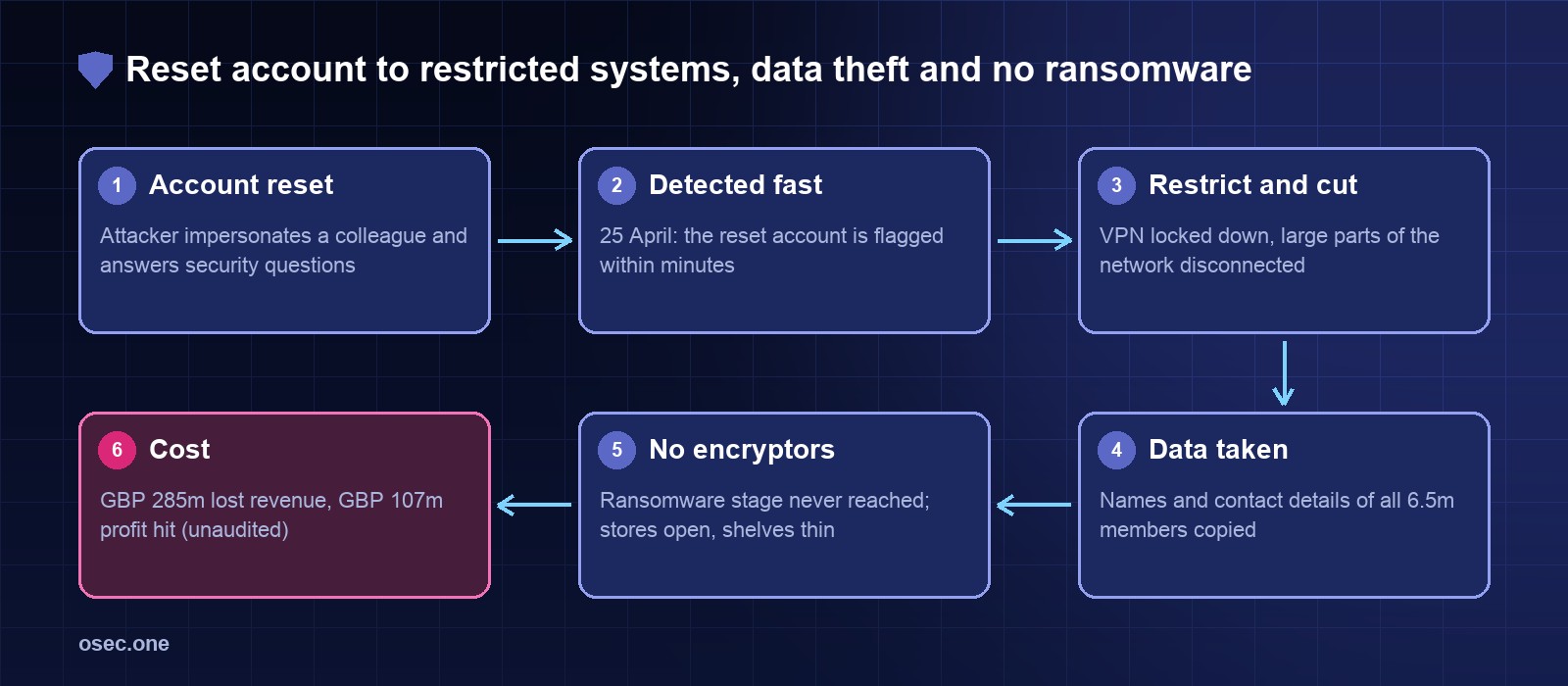
In late April 2025 the Co-op Group, was hit by the same wave of attacks as Marks & Spencer. It ended up on the better side of the comparison: no encryptors ran, stores stayed open and its own unaudited 2025 figures put the profit hit at £107 million. It still lost £285 million of revenue, had the member file of all 6.5 million members copied, and had thin shelves for weeks. This is what the Co-op has said under oath and in its results, what is only reported, and which controls decided each step.
What is established and what is only reported
| Claim | Status | Source |
|---|---|---|
| Attackers impersonated a colleague and answered a number of security questions to get an account reset | Established: Co-op's Chief Digital Information Officer Rob Elsey, evidence to the Commons Business and Trade Sub-Committee, 8 July 2025 | UK Parliament oral evidence, HC 835, as quoted by MTI and the trade press |
| The intrusion began on 25 April 2025, just over a week after M&S (17 April) | Established (Elsey: the account was seen acting maliciously) | Parliament evidence; MTI write-up |
| Defences restricted that account immediately; operations were segmented across zones and the response focused on one zone | Established (Elsey) | PoliticsHome, MTI |
| Ransomware was not deployed | Established: the CEO said the attackers could not erase anything because Co-op blocked them | The Register, 16 July 2025 |
| Personal data of all 6.5 million members was copied | Established: CEO Shirine Khoury-Haq, BBC Breakfast, 16 July 2025. No financial or transaction data | The Register, Express & Star |
| The group was Scattered Spider | Reported, not confirmed by the Co-op. Four people aged 17 to 20 were arrested by the National Crime Agency in July 2025 over the retail attacks and bailed; none charged at the time | The Register |
| The attackers claimed data on 20 million people | Reported claim to the BBC, 2 May 2025. The Co-op's own count was 6.5 million | Press reports |
One detail the sources describe differently: some reports say the Co-op "disconnected large parts of its network" and told staff to stop using VPNs; MTI's account says no full shutdown happened and only parts of the back end were paused. The Co-op's own wording in 2026 is that it "proactively restricted systems to contain the threat". Read "shutdown" below as restriction of large parts of the estate, not a power-off of everything.
Step 1: the reset (on or before 25 April)
The mechanism is the one in our Marks & Spencer analysis and the MGM and Caesars analysis: ring support, be a colleague, get the account reset. What stands out in Elsey's wording is "security questions". Those are knowledge-based checks: things a person can find on LinkedIn, in an old breach or by asking the real colleague a friendly question. A reset path that accepts them is only as strong as the least private fact about the employee.
Step 2: detection in minutes, containment in hours
Press accounts of the Co-op's testimony say the security team was alerted within minutes of the reset account behaving unusually, response measures started within the hour, a full incident process ran within 24 hours, and VPN lockdowns and forensic analysis were under way by that weekend (26 to 27 April). Elsey said the scenario had been war-gamed using a bronze, silver and gold command structure, like those government departments use.
| Date (2025) | Event | Status |
|---|---|---|
| 25 April | Reset account starts acting maliciously; defences restrict it | Testified |
| 26 to 27 April | VPN lockdown, forensics, wider restrictions on systems | Reported |
| 30 April | Co-op discloses a "developing" incident; some systems disconnected | Reported (ITV News, Co-op statement) |
| 1 to 2 May | Staff told to assume communications may be monitored; Co-op confirms member data was accessed after the attackers contacted the BBC | Reported |
| 8 July | Co-op's Elsey and General Counsel Dominic Kendal-Ward give evidence to MPs | Parliament record |
| 16 July | CEO confirms all 6.5 million members' data was taken | BBC Breakfast |
| 25 September | Half-year results: at least £206m lost sales | Co-op results |
| 26 March 2026 | Unaudited 2025 trading statement: £285m revenue and £107m profit impact | Co-op, unaudited |
Step 3: why segmentation mattered
Elsey told MPs the Co-op's operations are "segmented" across a number of zones, that the response "was very much focused on one specific zone", and that this let the team isolate the threat and stop malware being installed. Online retail and payments sat on separate infrastructure. That is the difference between the Co-op and a flat network where one stolen domain account reaches the virtualisation layer, which is what the ransomware crews rely on.
What segmentation did not stop was the data. The member file was copied before or while the account was being restricted. The CEO's own summary was that blocking the attackers meant they "could not erase what they did", not that they had taken nothing.
What it cost, in the Co-op's own numbers
| Item | Figure | Source |
|---|---|---|
| Half-year (to 5 July 2025) lost sales | At least £206m | Half-year results, 25 Sept 2025 |
| Half-year profit hit | £80m | CFO Rachel Izzard |
| Full-year profit hit, forecast in September | £120m, including any insurance recovery | CFO Rachel Izzard |
| Insurance | Front-end cover for the immediate response; "we don't believe we will be claiming on insurance for back-end losses" | CFO Rachel Izzard |
| 2025 revenue lost directly to the attack (estimate) | £285m | Trading statement, 26 Mar 2026, unaudited |
| 2025 profit impact (estimate) | £107m = £86m margin + £21m non-recurring costs | Same |
| Group revenue 2025 vs 2024 | £11,025m vs £11,279m (down 2.3%; up 0.3% excluding the attack) | Same |
| Underlying operating result | Loss of £35m vs profit of £131m (a swing of £166m; £80m worse excluding the attack) | Same |
| Underlying result before tax | Loss of £126m vs profit of £45m (£85m worse excluding the attack) | Same |
Worked checks on those figures:
- £86m + £21m = £107m, matching the stated total.
- £86m of margin lost on £285m of lost revenue is 30%: nearly a third of every pound of sales that did not happen, because the stores, staff and depots still cost money.
- £107m is 0.97% of the group's £11.0bn revenue, and £285m is 2.6%. Revenue fell by £254m, so without the attack it would have grown by roughly £31m (0.3%), which agrees with the Co-op's "broadly flat".
- The September forecast was £120m; the unaudited year-end figure is £13m lower, so recovery came in a little better than planned. The audited annual report was still to come when this was written.
- The attack accounts for about £86m of the £171m fall before tax; the Co-op also cites about £150m of other cost headwinds (including £47m of regulatory costs), so don't read the whole loss as cyber.
Against M&S: M&S reported £131.3 million of incident costs with £100 million paid by insurance. The Co-op's number is lower on profit but is not a cheap outcome, and unlike M&S it expects to carry most of it itself. It also said market share was back at or above pre-attack levels in every business area in 2026, and active members grew 17% to 7.2 million.
The decision to restrict, and when it pays
Restricting your own systems costs money every hour. The Co-op's lost sales of £285m is the price of a decision that, on its account, stopped the encryption step. M&S did not get that outcome. The point to take from the two cases is not "shut everything down"; it is that the decision has to be possible to make in minutes and has to be cheap enough to make early. That depends on prior work:
| Decision needed in the first hours | What makes it cheap | Control to check |
|---|---|---|
| Which accounts and VPN paths to cut | Admin and remote access can be disabled separately from the shop and payments | Break-glass admin accounts outside the main directory; VPN killable in one step |
| Which zone to isolate | Zones with no shared admin credentials; online retail and payments on their own infrastructure | Segmentation test: an account in zone A cannot authenticate to zone B |
| Whether stores and depots keep trading | Manual fallbacks (the Co-op's distribution centres and funeral services moved to manual and paper processes) | A yearly manual-mode drill for ordering and stock |
| Who says go | Bronze, silver and gold command roles agreed beforehand | Named decision-maker with authority to cut without asking for budget |
| How to tell staff | An out-of-band channel not on the network being cut | Phone tree or messaging not using corporate sign-in |
Controls that break each step
| Step | Control | Check |
|---|---|---|
| Reset by impersonating a colleague | Retire knowledge-based questions for resets. Use a callback to a number on file, a manager approval or a video check against the HR record | Count resets with no out-of-band step in the past 90 days: target zero |
| Reset account then used at once | Alert on a reset followed within hours by a new MFA device, VPN login or admin tool use; hold new devices from privileged actions for a period | Alert fires in a test with a fresh reset |
| Lateral movement to infrastructure | Separate admin identities per zone; no shared domain-wide admin; tier the hypervisor and backup consoles | Attempt a login from one zone's admin account to another zone: must fail |
| Data copy | Limit which accounts can read the whole member file; alert on bulk export | A bulk-read alert with a threshold in rows per hour |
| Slow decision | Pre-agreed restriction runbook with a cost per hour of restriction already written down | Tabletop with the real £ per day of lost sales |
For a small business the same list shrinks to three questions: can someone ring your support and get a password reset using facts from LinkedIn, can one admin account reach everything, and who is allowed to switch things off at 2am?
What to take from it
1. Account recovery is still the front door. Both the M&S and the Co-op intrusions started with someone convincing a person, not with malware.
2. Segmentation decides how bad the shutdown is. Elsey described one zone being dealt with; the Co-op's restrictions still cost £285m of sales, which is what a good outcome looks like.
3. Containing the attacker doesn't contain the data. All 6.5 million member records were taken. Containment limits encryption, not theft.
4. Write the cost of restriction down before the incident. At 30% margin on lost sales, £1m of lost revenue costs about £300k of profit; a team that knows that number can decide in minutes.
5. Insurance is not the plan. The CFO expected not to claim back-end losses.
The reset question goes away when there is no password to reset. osec.one logins use one-time email codes and Apple or Google sign-in, so your customers never call a help desk for a password, and there is no security question to guess. Free to start.
Add passwordless loginRelated on osec.one: Jaguar Land Rover 2025: five weeks of halted production is the other side of the shutdown decision, where a global IT network was severed and the cost ran to weeks.
Sources: Co-op Group, unaudited 2025 trading statement, 26 March 2026 (PDF); Co-operative News: half-year report, 25 September 2025; The Grocer: £120m profit hit; The Register: all 6.5 million members, 16 July 2025; UK Parliament, Business and Trade Sub-Committee, UK economic security, oral evidence 8 July 2025 (HC 835); MTI: M&S vs Co-op; PoliticsHome: Co-op evidence on segmentation; Techforce: the cyberattack that started with a phone call. Figures from the 26 March 2026 statement are unaudited. Co-op's cyber incident FAQ page could not be read automatically, so the list of member fields taken (names, contact details, dates of birth) is as quoted by the press, not checked at source.